Five niches worth starting a startup in, in 2026
You can build. You have evenings, a stack you know, and no idea you believe in yet. This is a list of five places where demand is growing this year, the incumbents are slow, and a team of one or two c


How we picked
Three filters, applied in order. Demand has to be visibly growing in 2026 sources, not in a 2021 trend piece. A two-person team has to be able to ship a first version in under two months with today's tools. And customers must already be paying for something worse, because a niche where nobody pays yet is a research project, not a startup.
The sources are Y Combinator's 2026 Requests for Startups, Bessemer's and Menlo Ventures' vertical AI reports, government e-invoicing calendars, Goldman Sachs and SignalFire on the creator economy, and our own catalogue. Every number below carries its source and date. Where a number is a vendor's or a venture firm's claim, it says so.
1. Software for AI agents
What it is. Tools whose customer is an agent, not a person. Billing that meters agent actions, memory that persists across sessions, auth that lets an agent act on a user's behalf, monitoring that shows what a fleet of agents did overnight.
Why now. Y Combinator's Summer 2026 request list includes "Software for Agents" with the line "the next trillion users on the internet will be AI agents. They need completely different software." Its Fall 2026 list adds "Self-Maintaining APIs" and "A Cloud for Small Software" for agent-built tools. IDC forecasts more than one billion actively deployed agents by 2029. Stripe announced 288 launches at its 2026 Sessions event and framed agents as economic actors.
What you would build. A usage-meter and invoice layer for agent products. Count actions, tokens or minutes, apply a price plan, produce the invoice, and expose it as an MCP tool so the agent can check its own balance. Price it per tracked event, with a free tier for hobby projects.
Who is already there. Mem0 for memory, Composio for tool integration and auth, Browserbase for hosted browsers. Each raised money in 2025 or 2026 and each is narrow, which is the point: the stack has many empty slots.
The catch. Platform risk. The model labs ship a memory or billing primitive and your slot closes overnight. Pick a slot the labs have no reason to own, such as invoicing across several providers.
2. Vertical AI agents for one profession
What it is. Software that does the work of one job in one industry, end to end. Not a chatbot for dentists, but the thing that reads the referral, books the slot, sends the reminder and files the insurance code.
Why now. Bessemer reported in September 2024 that LLM-native vertical companies were growing about 400 percent year on year at about 65 percent gross margins. It predicted vertical AI would be worth ten times legacy vertical SaaS. Menlo Ventures' December 2025 enterprise report put 2025 vertical AI spend at 3.5billion,nearlytripletheyearbefore,withhealthcareat1.5 billion of it. Bessemer's argument is the one to remember: software was one percent of US GDP, while business and professional services, which are mostly language tasks, were 13 percent.
What you would build. Pick one profession you can reach ten practitioners in this week. Find the single workflow they describe with a sigh. Build the agent that completes it and charge per completed task, not per seat, because the customer is buying finished work.
Who is already there. Harvey in legal, Abridge and Ambience in clinical documentation. Notice these are big markets with big funding. The opening for a small team is the profession nobody funds: surveyors, court reporters, freight brokers, veterinary practices.
The catch. You have to know the trade or partner with someone who does. Generic AI knowledge does not tell you which form a physiotherapist hates. Domain access is the moat and the barrier.
3. Cheap decisions inside existing software
What it is. Small, fast classification and routing calls that live inside a platform which already has the traffic. Is this comment spam. Which department gets this ticket. Does this listing break a rule. Made thousands of times an hour, for fractions of a cent.
Why now. The price of a single AI decision fell off a cliff this month. TypeSafe's Jev, launched 15 September 2026, prices input at 0.042permilliontokenswithoutputfreeandclaimssub−secondresponses,against0.20 to $10 per million for LLMs. Those are the vendor's numbers, covered in our Jev explainer. But the direction is confirmed by every lab's small-model pricing. When a decision costs less than a database write, you can make one on every event.
What you would build. A moderation, triage or quality-gate app for one platform's marketplace: Shopify, Zendesk, Discord, Slack, WordPress, Webflow. The platform brings the customers, you bring the decision layer. Charge per thousand decisions.
Who is already there. OpenAI's moderation endpoint and Hive for content moderation, plus the platforms' own built-in filters. Almost nobody is doing the specific, opinionated version for one vertical's marketplace.
The catch. The platform can build it themselves. Survive by being specific to a niche the platform will never prioritise, and by owning the rule set, which is the part customers tune.
4. Compliance paperwork for small businesses
What it is. Software that produces a document a regulator demands, correctly, on time, for a business too small to have a compliance person. One regulation, one country, one form, done for you.
Why now. The calendar is doing the marketing. Belgium made B2B e-invoicing mandatory over Peppol on 1 January 2026. Poland's KSeF became mandatory for large taxpayers in February 2026 and for most other VAT-registered businesses in April 2026. France requires every business to be able to receive e-invoices from 1 September 2026. Germany requires sending from 2027. The EU AI Act's transparency obligations under Article 50 took effect on 2 August 2026, even though the high-risk rules were pushed to December 2027 by the Digital Omnibus. Y Combinator's Fall 2026 list includes "AI-Native Compliance Infrastructure". The indie-hacker roundups call this the boring niche that prints money, and they are right.
What you would build. A single-country e-invoice sender for freelancers and micro-businesses. Connect the bank or invoicing tool they already use, produce the compliant format, submit through the national channel, and keep the audit trail. Belgian access points charge €20 to €50 a month plus €0.10 to €0.30 per document. Undercut that for the one-person business.
Who is already there. Vanta and Drata for security compliance at the enterprise end. Banqup, Babelway and e-invoice.be as Peppol access points in Belgium. The gap is the sub-€20 product for a sole trader who sends eight invoices a month.
The catch. Regulation changes under you. Poland delayed KSeF twice. Budget time for reading gazettes, and build the format layer so a rule change is a config change.
5. Creator operations
What it is. Back-office tooling for people who earn from content and have no staff. Sponsorship pipeline, invoicing, contract templates, repurposing one video into ten posts, community moderation.
Why now. Goldman Sachs projected the creator economy to reach roughly 480billionby2027from250 billion in 2023. SignalFire counts over 50 million people who call themselves creators, about two million full time. Goldman also reports that brand deals make up about 70 percent of creator revenue, which means the sponsorship workflow is where the money moves. Yet half of creators earn under $15,000 a year, so they cannot hire the operations person a media company would.
What you would build. A sponsorship CRM with invoicing for mid-tier creators: track the deal from first DM to paid invoice, generate the contract, chase the payment, report the deliverables. Flat monthly price under $20 rather than a commission, because creators resent giving up a cut.
Who is already there. Passionfroot, which takes a 5 to 15 percent commission on deals. Beacons, which bundles invoicing into a link-in-bio product with a revenue share. Grin and CreatorIQ at the enterprise end for $25,000 a year and up. The middle, flat-fee and creator-owned, is thin.
The catch. Creators churn when income dips, and income dips often. Low support load helps, and so does pricing that tracks their revenue without becoming a commission.
What makers are already building
Every other list like this stops at the analyst reports. We run a launch board, so we can look at what people actually shipped. Here is the share of the 611 products listed on AppBoard.pro between 2 August and 22 September 2026, by the categories closest to these five niches. A product can carry more than one category, so the shares overlap.
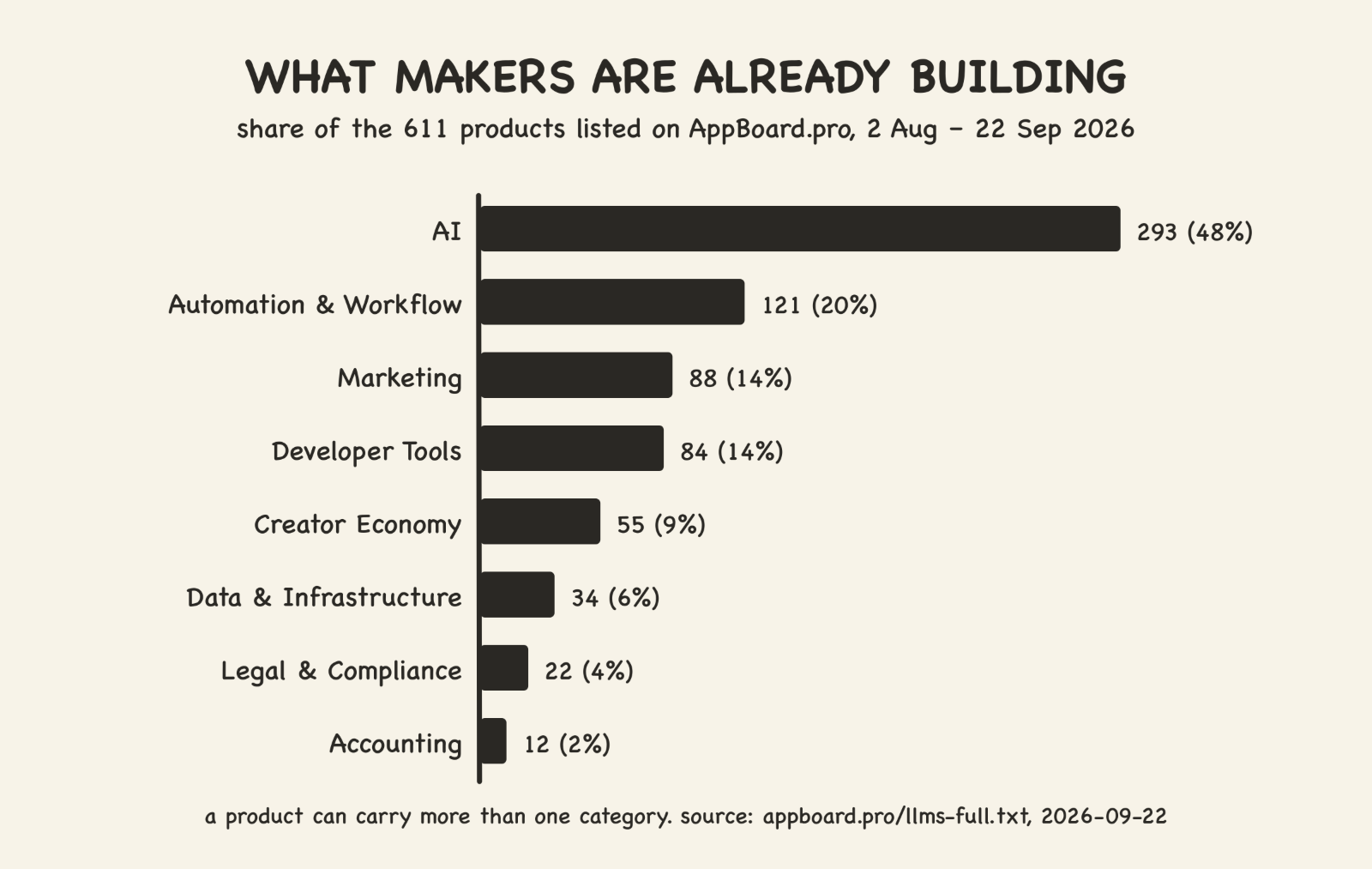
Three things stand out.
Almost half of everything launched is tagged AI. That tells you where the crowd is. It also tells you that "AI" alone is not a niche any more. Of those 611 products, only 24 mention agents, agentic or MCP in their name or tagline. Niche one is far less crowded than the AI headline suggests.
Automation and workflow is the second-largest category at one in five. That is niche three's home turf, and it is busy. The way in is specificity: an automation for one platform's one problem.
Compliance is nearly empty. Legal and Compliance is 4 percent, Accounting is 2 percent, and only 12 products anywhere in the catalogue mention compliance, invoicing, GDPR, audits or regulation in their tagline. Against a calendar of hard legal deadlines in four large European markets this year, that is the widest gap on the board.
These are counts from a seven-week-old catalogue, not a market survey. But if you wanted one signal about where makers are not looking, niche four is it.
How to choose one
Three questions, answered honestly, pick the door.
Which one can you talk to ten customers about this week? Not post about. Talk to. If the answer is none, you do not have a niche yet, you have a reading list.
Which one have you personally paid for something worse in? Your own invoice pain, your own agent billing spreadsheet, your own sponsorship chaos. Founders who were the customer skip six months of discovery.
Which one can you ship a floor version of in 30 days? Not the product. The smallest thing a stranger would pay for once.
If two doors pass all three, pick the one with the calendar on its side. Deadlines sell software that quality alone does not.
What to do now
Pick the niche, write the one-sentence promise, find the ten people, and build the 30-day floor. When it is ready, launch it on AppBoard.pro. It is free, and the categories above are exactly where the next maker will be looking for what you made.
Sources: Y Combinator Requests for Startups (Fall 2026) · YC Summer 2026 RFS, via The VC Corner (2026-04-28) · Bessemer, The future of AI is vertical (2024-09-03) · Menlo Ventures, 2025 State of Generative AI in the Enterprise (2025-12) · IDC on agentic AI spending · Stripe Sessions 2026 · E-invoicing mandates in Europe 2026, SPS Commerce · Gibson Dunn on the EU AI Act Omnibus · Best Peppol access points 2026 · Creator economy statistics 2026 (Goldman Sachs and SignalFire figures) · Passionfroot for creators · AppBoard.pro full catalogue (2026-09-22).
0 comments
Sign in to join the conversation.
Loading…